Showing posts with label Suzanne Edney. Show all posts

Thursday, June 2, 2016

VARIATIONS ON A PINK THEME


I have to begin with this shrub's Genus, species and cultivar name. Hydrangea serrata 'Preziosa' belies it's name as mysterious and magical just as the variations of pink are that show up on the hundreds of florets that make up the 6" -8" diameter floral umbels.  


I first saw a young plant in bloom at a friend's house while touring her garden.  On request, she kindly rooted a cutting. Four years into growing this beauty on the north east corner of my house it is spectacular. 


Here in the Piedmont of North Carolina the weather this spring hasencouraged unprecedented  growth.  Cool nights coupled with lots of rain has made it feel like the Pacific NW. Landscape plants are catching up with the predictions of mega Poison Ivy leaves. I have never seen such abundant growth with large leaves on many plants growing in my garden in a woodland. 


This Hydrangea has never bloomed so prolifically. Well, maybe because of its youth.  In any case I luckily placed it well for thriving growth and don't you like the pink against the gray house?  The color combo reminds me of a 'Poodle' skirt my sister wore in the 1950's.  HA


Tuesday, May 10, 2016

SEARCHING FOR BLUE


Blue is a rare color in any garden. Those who love the hue often have to supplement their gardens with objects of that coloring. I have a few strong cobalt blue objects including a ceramic disk, largish mushroom, glass ball, whimsical Eye sculpture and the preverbal blue bottle tree to catch the 'haints" before they reach the house. Cobalt blue is an intense color and I like it in small doses.

Blue ceramic disk with an unusual selaginella nestled in the corner of a trough garden. 

Blue mushroom in a sea of Periwinkle

Glass bowl in a concrete container by Lasting Impressions in Raleigh, NC. Nearby a Cypress knee and Cephalotaxus harringtonia cultivar hover overhead

Blue Eye sculpture by Cam McCamy of Wake Forest, NC and a lone Tradescantia seedling

In the first photo of this blog you may have noticed something blooming on the bottle tree. It is a cut stem of Tradescantia virginiana (Native Spiderwort) tucked into a branch of the tree.  As you see, the color more violet than true blue, but, i happen to think that  times in the garden it makes a darned good substitute for the color blue. 


Below are images taken this morning while blossoms were fresh before  melting away in the heat of the day. The bluish purple color of each seedling is subtle.   Even so, the range of blue violet color comes through as a strong visual element.

With Iris Sultan which , by the way, looks spectacular with any red Loropetalum. 

In the same planting bed as above but looking through a metal leaf sculpture and across the drive to the compost bin. 

A large old clump in the new rock garden

Wrestling with Woodwardia and Holly Ferns 

Using a huge Hosta as a backdrop. 

Looking like bits of midnight blue sky dropped into the garden. 

This native scatters its seeds around my garden freely and where I don't want it I cut it to the ground or dig it out.  Once the stems become top-heavy with spent blossoms they tend to flop over.  It is easy to just snap off the stems near ground level to tidy up.  


I wonder if John Tradescant, the elder who brought back this native plant from the colonies to King George III of England and who's name was given the plant by Linnaeus had blue eyes matching the color of the flowers. I love thinking that a piece of history resides here naturally. It's discovery for garden use in the mid 1600's adds intense color and interest fitting in anywhere and thankfully enjoys the acid soils of my garden in a woodland. 


https://edneysuzanne.blogspot.com/

"Welcome to the beautiful world of gardening where creativity and healthy activity meet!"

Monday, May 9, 2016

LOTS OF SPRING RAINS BRINGS A SNOWY REWARD AND A RIVER OF PURPLE


It's the beginning of May and Mother's Day has been heralded with clouds of Saxifraga stolonifera along the drive and pathway edges where it has been allowed to spread with unbridled shame.  Hundreds of blossoms, as if in flight, crowd around the rain gauge. Further up the path streaks of the Strawberry Begonia lead your eye up to a Hydrangea beginning to bloom. 


Hydrangea serrata 'Preziosa' becomes a backdrop with snail pipe sculpture. 


Selaginella and Tradescantia grapple for space as the airy "butterfly" blossoms of the Begonia fly toward a metal butterfly in this garden vignette.  


Nearby purple and lilac are opposite each other along the broken concrete path to the front door. 


A river of Oxalis regnellii swirls along and mimics french curlicues on a welcoming bench. The pale lilac Iris virginiana 'Contraband Girl' is in the background. 


A single Saxifraga is tucked in under watchful eyes with Iris 'Eco Easter' , Asarum canadensis and Hosta yingeri.  


Behind the waterfall of Strawberry Begonia blossoms (below) is a stacked stone wall. I planted on top of the wall and this plant found it's comfort zone between the crevices. 


Even though Saxifrages' natural habitat is among rocky cliffs with perpetually seeping water you can successfully grow this one if you have the space and conditions of cool moist well drained shade. This wonderful wandering ground cover may be the plant for you. 


Sunday, March 20, 2016

A WALK IN THE SPRING GARDEN IN MY WOODLAND


Pictures are worth a thousand words and at this moment, needs other than my garden are taking precedence in my life. Luckily, my garden has been planted and orchestrated to largely take care of itself.  It is now a haven of peace and joy with little necessary management . 


One of the best Viburnums for deep shade that tolerates my very acidic soil is Viburnum burkwoodii perfumes the air at the entrance of a moss garden with a stone meditation bench watched over by Buddha. 

Details to watch for on the dry woodland floor are many types of colorful Epimediums AKA Fairy Wings. 


.......and emerging whirls of Japanese Roof Iris, Iris tectorum. Be sure to protect from voles with Permatil in the planting medium.  Light hand weeding around the clump will take a few seconds before the annual interlopers set seed.  I never got the pre-emergence in place in January. 

Below are two striking spring foliage juxtapositions.  First is a chartreuse Abelia below the huge drooping blue, black, green leaves if Viburnum rhytidophyllum. 


And second a combination growing through each other of Loropetalum and a special Ligustrum purchased years ago at Montrose in Hillsborough, NC. 


My main moss path is full of Bluets. 


Kerria japonica is in full bloom. 


Finishing the brief afternoon walk on a gray day I see Magnolia 'Susan' blossoms fluttering over a Joel Hass butterfly sculpture. 


Don't let a gray day keep you from enjoying the intensified color in your spring woodland. 


Saturday, January 23, 2016

WHEN THERE ARE NO WOODLANDS TO PUT A GARDEN UNDER


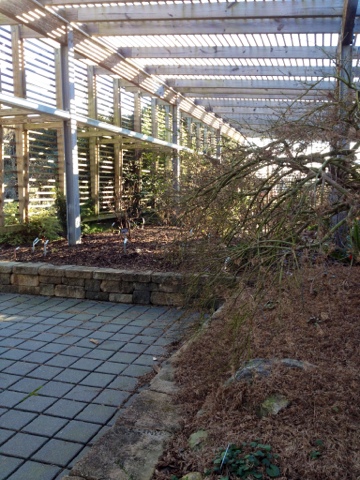
The idea of a shade house to grow plants that require filtered light is not a new one and structures for this specialized purpose have come in all sizes and sorts. From arbors, open screened roofs on poles to the more practical lath house the choices and designs are endless. Above is the marvelous pergola/arbor at Fearrington Village in Pittsboro, NC,
AND See a previous post about this subject: "STRETCHING THE DEFINITION OF CANOPY"


 If you are ever in Raleigh, NC,  you will have the privilege of walking through a most unusual open shade house.  About 40 years ago the grounds that would become the JC Raulston Arboretum at NC State University in Raleigh, NC was wide open. It was a place for professors of horticulture to field trial all manner of plants that could not thrive in full sun. There were few mature trees and no design yet in place that would make up the eventual 10 acres of the JCRA. It is now a world renowned teaching facility, research garden and pleasure grounds that thousands of visitors enjoy throughout the year. 


JC Raulston's vision of a place to test the hardiness and viability of plants from the world over began on a "shoestring budget".  This meant that many of the plants he acquired were small and initially required a specific outdoor growing situation for optimum observation and evaluation.  Partial shade from the hot, bright, humid summer days of central NC was essential to the survival of the new plants. 

                       East Entrance

A 20 year old specimen greets visitors at the East Entrance

If you are exiting the Lath House at the East side you can peer through 70+ year old Dwarf Loblolly Pines into the Elipse Lawn. 

And so was born, The Lath House. The early structure was quite simple with sturdy round poles holding up snow (or dune) fencing to create the correct amount of sun and shade. The slats of the fencing were oriented north to south providing  moving shade as the sun passed overhead from east to west. 


Over the years the Lath House became an iconic feature of the arboretum experience with winding paths and cinderblock raised beds. Now, replacing the original structure, is a state of the art and award winning sleek wood and steel LATH HOUSE designed by Architect Frank Harmon and dedicated in 2012.  

From 2008 to 2010 the Master Planning Committee worked on designing the contiguous walk through the Asian Valley, The Japanese Garden and into the Lath House. Not shown are myself, Judy Harmon and Bobby Mottern. 

Exiting the Lath House on the West side into the Japanese Garden. 


A stimulating yet practical  arrangement of raised bed gardens designed by the JCRA Master Plan Committee grace the floor plan. Still entering from east or west, the flow for visitors is two fold. Large tour groups can pass through the middle quickly while singular guests wanting to study plants in more detail can stay to the sides winding in an out of several path choices. There is seating on the bed walls throughout the raised gardens. 
Growing in a mix of compost and Stalite, traditional  research continues on plants from all over the world in this beautiful space that simulates a garden in the dappled shade of a woodland.  Beds were filled with a mixture of compost and Stalite better known as Permatil in retail establishments.  And so the plants grow!!!! 


Visit the JC Raulston Arboretum, in Raleigh, NC to travel the world by seeing plants that started their evaluation in the Lath House. 

Thursday, December 24, 2015

BARK AND BUDS ABOUND IN THE WINTER GARDEN


For year round interest in gardens in woodlands, look for every detail offered up by the trees and shrubs. The bark of my magnificent trees are doubly enhanced when an interesting branch of a flowering shrub full of next springs buds crosses in front. Above is an almost perfectly horizontal budded branch of 'Shasta' Viburnum in front of an impressive Loblolly Pine.  The evergreen behind is Canadian Hemlock. 


Two smoothed barked trees with pointed buds from their own branches are: Stewartia monodelpha, left, and native Magnolia tripetala, right. 


Tulip Magnolia Buds in the Coker Arboretum at UNC Chappell Hill NC. 


I grow my gardens under native Dogwood, left, and Loblolly Pine with sprinklings of Sweet Gum trees shown on the right.


Winter flower buds of Mahonia bealei, left, are breaking out in upright yellow clusters of tiny fragrant bells while a dwarf 'Temple Bell' Pieris , right, holds tightly on to decorative buds until early spring.  These two shrubs also keep their leaves through the coldest temperatures. 


On the left, snowy dots of a Corylopsis shrub add a textural depth to this part of the border along the driveway. On the right is an all time favorite.  A show stopping display of twin pairs of silvery satan buds are seemingly adrift on the tips of Edgeworthia 'Cream Ball'. The buds will open in March and flower for a month perfuming the front courtyard. 


Did you guess that these are both Tulip Poplars? On the left is our native Liriodendron tulipifera and on the right, from China, Liriodendron chinense.  The difference in the bark is striking as are the size and shape of the leaves. I consider them sister trees uniting from around the world.  In my garden they grow almost side by side. 


I was introduced to this green barked Maple seedling at Camellia Forest Nursery and had to try it.  It is flourishing in fairly deep shade on 4.9 pH soil.  On the right is the sensuous bark of Magnolia x loebneri 'Merrill'.  It is an upright tulip type Magnolia with reliably hardy buds that casts its flowery fragrance 300 yards away.   


Rhododendrons hold their buds in the center of wonderful splashes of leaves.  R. catawbiense, on the left, is evergreen while R. australis, on the right, will drop its leaves as the weather cools to winter temperatures. 


 Showy buds of two other evergreen shrubs are on Winter Honeysuckle, left, where single buds sit in each  leaf axil along the stems blooming off and on through the warm spells of winter. The plant on the right is an Agarista, previously known as Leucothoe, showing sprays of buds nestled in the leaf axils and the very tip of arching stems.  The buds wait all winter to expand in the spring. 


Chunky or flakey bark on two very different trees always catch my eye in winter. On the left is the stately single trunked native Persimmon and on the right, hailing from Europe, is the flaking bark of multi trunked Cornus mas. If you love the bark of a River Birch but haven't the room and want a shorter tree this is one to consider for smaller spaces. 


The left hand picture shows our native Red Cedar which is actually a Juniper. The peeling bark is prized by birds for nest making. On the right is a fantastic ornamental shrub/tree that can be pruned and managed as more upright to be able to better appreciate its mystical white exfoliating bark in the winter. Hepticodiym miconoides is hardy from USDA zones 5-8 and is a wonderful pollinator that blooms in late summer. Google:  Chicago Botanic Garden and Seven-Son-Flower in the same line for more information on the reintroduction of this unusual plant into our western gardens. 


Above is a distant early spring view of Hepticodium on the left and Cornus mas on the right in a south facing border at the edge of the woods.


Finally, the bark of two of my finest trees. On the left, looking for all the world like a giraffe, is Lagerstromea fauriei, the Japanese Crape Myrtle. Standing 25' tall, exfoliating cinnamon bark envelopes the trunk to the uppermost branches. Summer blooms are fragrant white. I love the carpet of tiny falling petals without any messy seed capsules later. You must have lots of room in your garden to grow this tree. On the right see how rough and almost charred looking the trunk of Prunus mume 'Peggy Clark' is. 

  
Above, buds along the stems of Prunus mume 'Peggy Clark' fatten and burst reliably in December with a delicious spicy scent.  It will flower for a month and produce a summer fruit that the Japanese love to pickle and eat daily.  Thus, it's common name, Japanese Flowering Apricot. 


Let us end this conversation with the showy yellow of autumn leaves carpeting the ground beneath, from left to right, Magnolia x loebneri 'Merrill', Lagerstroemia fauriei and Cornus mas. Planted 18-20 years ago, their arching branches have made a small woodland garden space all their own where they continue to delight on winter walks with their very own unique characteristics of unusual barks.