Showing posts with label loppers. Show all posts

Sunday, June 14, 2015

VINE WARS


When you fall in love with the idea of planting a vine to cover that brand spanking new arbor you just built, plan on investing in at least a 7' standing ladder, expandable hand loppers and a 10' pole saw. As you carefully plant your baby vine,  I promise you, these items will be needed down the road after a number of peaceful years of clinging, twining and climbing. 


I didn't think planting smallish trees (Redbud, Japanese Maple, and Styrax) ten feet from my arbors would become attractive supports for my vines. The 20' growth habit of Carolina jessamine began taking over the Japanese Maple and the Styrax during the fourth year requiring an annual pruning and pulling of the twiner out of the trees. 
The Clematis armandii just wasn't satisfied with the 8' tall arbor I built for it and clambered 18' ( exceeding it's suggested 12-15' ht.) into an Oklahoma Redbud. I guess a Vine will be .... a Vine... DUH!


After 10 years the vines had built up to a 6" layer of tangled vines and dead leaves completely covering the arbors. This mat of vegetation supported a thriving wildlife habitat including, last spring,  a nesting pair of Mourning Doves. 


Above is a before (1991 left) and after (2015 right) 

Now, the summer 'jungle' of vegetation is pressing in and I've decided to get ruthless, release the trees and let the sun shine through the rafters once again.  (The fledgling birds have departed.)


On one of  the arbors I had originally planted a Mermaid Rose. Falling in love with the charm if it's name and the lovely pale yellow single form of it's flowers. I was convinced at age 45 I would be able to manage her forever. She proved to be too aggressive an adversary in short order with her ungainly stems and claw-like thorns. I removed Ms. 'Mermaid' in the year 2000.  After enjoying Her last blooming breath of spring bloom, out came the 2" X 2" supporting rafters along with my 10' pole saw and the Mermaid Rose. 


Above, loose rafters dropping to the ground


Rafters looking like a giant pick up sticks game.  


Let me explain:  the (12) 2" X 2" treated lumber rafters rest on the beams of the arbor unattached by hardware. this allows easy access to the plants that overgrow the arbor. 


When the rafters are removed by sliding them out I use a pole saw to cut out the huge square of matted vegetation near the beams. It's like a huge piece of cake.  
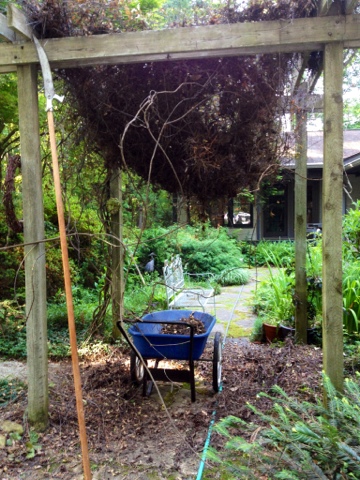


A big cart placed underneath the arbor catches it in one piece and it is then easily hauled off into the rough woods. 


I'm using this same technique to cut back the Carolina jessamine. As I cut I hear the voice of Rosanna, a friend of mine who was the Garden Leader in the Lath House at the JCRA in Raleigh, NC. Her reverberating plea was, "No more vines, no more vines". Shall I leave a tiny note near the arbor like the little mice in Beatrix Potter's "The Tailor of Gloucester" .... "No more twist, no more twist."? 


Above are the recent cuts to the Gelsemium sempervirens close to the top of the arbor.  Below, the job is finished letting more light into the garden.  It will be curious to record the recovering growth of the Carolina jessamine. 


Because, I have to admit, the effect was magical with it's  heady spring scent in the entrance courtyard.  I will be looking forward to the beautiful vision of the arbor with "the fringe on top."

Wednesday, March 11, 2015

EARLY SPRING DEBRIS DUTY


"What's that?"
"A leaf left over from last fall !"
"Well, let's get busy and clean it up."
"There, that's better."
"Now, on to all the Pine branches that fell off in the ice storm last week."

"Garden Eyes" sculptures by:
Cam McCamy 


In my gardens in the woodland there is sure to be a few hours or even days in February and March of semi- heavy clean up of fallen branches that have succumbed to wind, heavy snow and ice.  Winter Nature's elements are most destructive to Pine branches. The Loblolly Pines (Pinus taeda) are the trees most affected.  In this garden the trees range from 50 to 100 years old. Some of their branches are as high up in the trees as their age!  Below is a view of the southern edge of the woodland. You can get an idea of the height of the Loblolly Pines by comparing them with the bare branches of Hepticodium myconoides in the foreground and the Cornus mas in yellow bloom in the distance. Both of these are 15' and 20' tall respectively. 


The girth of old branches are sometimes 9" in diameter.  Below is a picture of the huge trunk of one of the Pines in a sitting area near the Fern Walk.


When the winter storm precipitation clings to the limbs we are on high alert for falling branches. We poke our head outside the house and can hear crashing throughout the icy stillness of the day. The branches heavy with snow and ice are making their way to the forest floor from magnificent heights. There is no walking in the garden until the ice has mostly melted. 


Then, out comes my Felco pruning saw and loppers for cleanup. There is usually no need for a chain saw as a 6" Felco,if kept sharp, will make quick work of even the 9" dia. branches. 


Today I worked on the debris that fell across the Fern Walk path. You can see how the branch leaning against the trunk on the left fell like a spear into the ground. That happens throughout the year in wind storms as well. It's always a shock to come across what looks like a juvenile tree that has magically appeared and find that it is a huge fallen branch that has stuck itself in the ground sometimes a foot deep. 

 Down on the left of the picture below, you can see the beginnings of a pile of cut branches.  I started  by cutting a longish branch to lay on the ground as the base, to make a crude sled with the cut end of the branch facing the direction of where I will be dragging the cuttings and piling smaller branches on top.   When the pile is of a size I think I can manage it is dragged into an area of rough woods that is not part of the managed garden.  


Below is the finished path looking toward the sitting area where you can lean back and enjoy the looking up at the tree canopy. 


I had a visitor ask how I manage all the falling branches that must come down from the trees. Once the side branches are cut off I will look for a place along a path to use the long left over trunk to define a path edge. This is a good way to recycle those 'gifts' from the trees and articulate a leafy path from the planted areas. 


This little task took about 45 minutes. 
So now I can concentrate on cutting off the cold damaged leaves of Helleborus x orientalis. 


There is nothing like having a clean look to a beautiful spray of Helleborus orientalis blossoms. This one planted and blooming happily below Daphne odora 'Aureomarginalis'


HERE COMES SPRING!!!!