Sunday, November 29, 2015

EXPERIENCING A CANOPY OF WORLDWIDE NATIVES


On a crisp fall day I found myself walking through the JC Raulston Arboretum's Mixed Border in Raleigh, NC.  It's always so exciting to revisit trees planted over 20 years ago that are still thriving.


The old trees are now mingled with a few of our own North America native species and newer specimens of cultivars and varieties ranging in origins from eastern Russia, Europe,Turkey, many Asian countries including: Japan, China, Taiwan,  Vietnam,  Korea. Look for the complete name tags (below) that identify the plants and the parts of the world where they grow naturally. 


Euonymous europeaus 'Red Cascade' (above) is naturally found in the infamous hedge rows of England but underused in our landscapes. 


Let me take you on a ramble over the a rustic stone path, through a central arbor and under this unique collection of trees with a series of images that I took a few weeks ago. 

The specimens are old enough now to enjoy the unusual bark on limbed up trees planted close to the path edge. 


I planted this Lagerstroemia limii (above) when The Mixed Border was first established in 1994-5. The seeds of this species of Crape Myrtle coming to the National Arboretum in 1981 from the Shanghai Botanical Garden , people's Republic of China were the beginnings of a breakthrough breeding program that brought the colorful mildew resistant Crape Myrtles we know today by American Indian cultivar names. The first to be introduced was the vibrant deep red flowering L. 'Arapaho'. 


Pinus wallichiana 'Zebrina' is a touch of the Himalayas in Central NC. It was another of the first trees to go in.
Below, see it on the right side of the path.


Pinus wallichiana 'Zebrinus' sprays of soft looking variegated needles hoover over the path as we continue to the central arbor. 


The central arbor seen from the east and west sides. 


The arbor is a central feature of the Mixed Border where you can sit for awhile and contemplate the framed living pictures of plants. There are many shrubs and perennials under the larger trees. Two familiar plants that grow contentedly in the shade and root competition of these trees are Gardenia and Spirea. 


Gardenias are considered an  'old timey' Southern standard. This unusual variegated Gardenia (above) surely had it's evergreen origins in China. In my limited research I found out that the pure green leaved type was first grown in Charleston, SC in 1762.  

Below, you can see a successful combination of a few of the woody plants at the west entrance to the Mixed Border. From the top down is Chinese Tulip Poplar tree and to the right of the Tulip Poplar the Nellie R. Stevens hedge with an arched passageway cut through. Progressing down see evergreen Daphniphyllum macropodum, Illicium, and closest to the ground, Spirea thunbergii 'Ogon'. 


Fine golden leaves of Ogon Spirea can be a great textural change in a mixed border of shrubs and trees. Look up this plant to understand its origins and find out how Carl Peter Thunberg traveled from Sweden to Japan to bring back  then unknown plants to European gardens. In 1775 Thunberg used the term 'Japonica' as an epithet for 254 species collected from Japan that had been introduced by the Japanese into their own country from China. How many times have you heard someone say "I have a Japonica."? 


The Mixed Border is situated opposite The JC Raulston Arboretum's renowned Perennial Border. Thus it is a stellar example of how plants perform on the north side of a Nellie R. Stevens hedge that casts a 15' to 30' shadow over the entire 200' of garden.  Homeowners can walk this border and take away ideas to implement in their own gardens that may have similar shady growing situations. 


Visit The JC Raulston Arboretum any day of the year to experience this long narrow woodland garden walk in the presence of trees from all over the world. 


Ps,  The Mixed Border garden is cared for by Garden Leader Amelia Lane and "The Border Babes".... A dedicated group of talented gardeners in their own right. Staff support ranges from interpretive signage to propagation of new plants to trial. Additional vibrant volunteer groups of labelers, mappers and construction crew and others are vital to the overall success of this garden experience. 

Thursday, November 19, 2015

WOODLAND RAMBLE ON A HILLSIDE OF OAKS


Today I visited my good and talented gardening friend Rita Mercer in her garden under a mature canopy of Oaks. Her house sits at the top of the hill nestled under the canopy of these majestic trees.


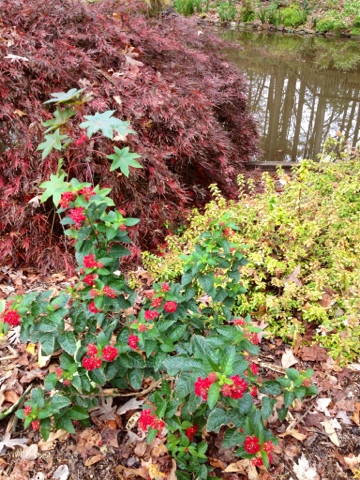
The overwhelming theme at this time of the year is red with touches of chartreuse seen below with Yucca 'Colorguard', designer Abelias, Lantana, Caster Bean and cultivars of Japanese Maples with leaves coloring to red each Autumn. 


The garden tumbles down the steep south facing hill to a placid pond carved out of a gently flowing stream. 


The last dots of red Lantana bloom greet you at the street before crossing over a bridge to climb the driveway on the western edge. 


Rita has been gardening here over 20 years and still finds working in her garden a thrilling experience always experimenting with adding and editing for glorious color as the seasons come and go.  

Thanks Rita for an inspiring afternoon. 

Wednesday, November 11, 2015

COLD COMPOSTING AT THE EDGE OF THE WOODLAND


Years ago I picked up this two tiered compost bin with lid from a garden store that was closing in Raleigh, NC.  The compost bin sits on a south facing woodland edge of my gravel driveway. An attractive sunflower grill, a gift from my wonderful brother in law, was a welcome addition to dress it up. 


It is in a convenient location for dumping in vegetable scraps, weeds without seeds, cut up prunings, egg shells, bits of cardboard, used paper towels, leaves, small twigs in layers and even an old cotton T-shirt or two. This is cold composting at its finest for a busy gardener who doesn't rely on the compost he/she makes for the garden. I have not had to turn or move the composting for 5 years now. The bin is still only 3/4 full. 


I keep a large baked enameled mixing bowl on the kitchen counter close to the sink and behind my cutting board. It's covered with a dinner plate when I'm not cooking or chopping. I like this size because I only have to empty it two to three times a week and feel good that 1/2 my garbage is staying on my property. Some call this sustainable. See the Blog Post:  Path Making Can Sometimes =File Clearing


The bin doesn't have to be beautiful or in sight. Here is one in a friend of mine's work space.  It's also being used here as a sort of nursery with plants waiting to go into the garden stored along the inside edges. The  cement blocks as the surround are stacked three high. 


So, you can compost in a woodland,  just don't count on that compost to feed your garden for a good number of years.  In the meantime the bagged offerings of compost are a good alternative. 

Wednesday, October 28, 2015

MOVING MOSS


The Fall , for me, is the best time to establish a moss garden. As the temperature drops the mists and moisture rise from the ground. Leaves falling cover bare earth spots where you harvest.  Above was the mossy " slippery when wet " state of a stone path. So it was time to clean, restore and harvest the moss for a new moss pathway. Resident toads have found their winter hibernating homes in other places in the garden so I'm hoping they stay burrowed while I scrape and clean the stone surface. 


I have somewhat of a moss farm right in front of my house.  After 4-5 years a 40' long stone path and terrace on the North East side of the house is over 1/2 covered in moss. This will be the fourth harvesting of moss from this area  in the 20 years since the stone walk and terrace were built. 


A trusty spatula easily lifted the moss that was placed in alternate upside down stacks in a flat cart for transporting to its new location. 


Out came the brush broom and a combination of bleach and an enzyme cleaner.  


The sudsy mix looked like a waterfall. It stayed on the surface for an hour. I did this twice while I laid the new moss path. 


I raked away the mulch and debris down to the parent soil where I wanted the path;  watered the heck out of the path to make  a cushy sometimes muddy base.


Then I began placing the moss pieces. Once the path was full of moss I watered again and foot tamped it down. I always love this part. Besides being finished with bending over I feel like a kid again with no cares in the would except sloshing about in a puddle. I was careful not to kick the moss out of place as I sloshed all over it.  


The path looks a little lumpy but the moss will knit into place by springtime. 


WARNING: If you are in a healthy woodland filled with creatures of the night .... Protect the moss with a wire mesh of some type pinned over the moss so the those little brats don't tear it up trying to find bugs and grubs for their midnight snack. 


Three hours later I had a new moss path and a safe and cleaned stone walk. (Somewhat sterile looking, I admit) but, I won't have to wait long for the moss to re-cover the path again. 


What better reason to clean off a stone path than to have company coming to visit. I don't want to take any chances if them slipping and falling.  Isn't that when we get our houses the cleanest? No more ROCKS SLIPPERY WHEN WET!!!

CACOPHONY OF COLOR AND TEXTURE AS AUTUMN ARRIVES


I remember trying to learn that last layer of knowledge about the fall color of plants to incorporate into my landscape plans and struggling to keep spring, summer, fall and winter in my mind for each plant.  I now think that just about any fall color mixture is what Mother Nature intended. Fall color is here for such a short while, so focusing on leaf texture, plant shape and size plays more of a roll when final choices are made. Above are the leaves of our native Dogwood and Redbud embracing a jaunty Yellowwood reaching for the sun. 


In my gardens in the woodland I like it better to be utterly surprised and enthralled when the magic of the coloring leaves visits the senses every year.  I walked under the Sassafras on the upper right of the picture and didn't even notice it until I was turned around coming back on the same path. I love how it dangles above the big Canna Banana leaves in the foreground. 


If it's possible to back light a particularly vibrant fall leaf, go for it.  But, don't fret if you can't always do what the design books tell you. Here huge Paw Paw leaves face the southern sun opening in the trees. 


I took a turn around the woodland two days ago and saw colors I had forgotten about. I think the light of the sky was just right for me to see these beauties in my woods and at the edges dancing to the gentle southeastern breezes that bring such pleasurable weather to North Carolina in October. Starting from the driveway I was drawn toward the 4 year old Acer 'Bihou' shining against an evergreen background and the Honey Locust, Sumac combination on the right. 
Below are two shots from different angles of those trees. 


Cardinal Vine grounds this picture as it drapes over a quince. Below is the young Acer 'Bihou'

.

Turning around, the now 20' tall Coralbark Maple, is set against the sun and cradled in the arms of a China Fir. 
That streak of light coming in from the upper right corner is a spider's silk thread.  The foreground is filled with Abelia chinensis. 


Native Grapevine hangs with a spirit man leaf on a Winged Elm. Finely cut leaves catch the light in a chartreusey puff on a Vitex Tree and the creamy buff color of giant Solomon Seal leaves adds to the experience as they droop over the path. 


There is an abundance of early yellows in the air along with flaming orange and deep crimsons. 


Flaming vines, like torches, show themselves 30-40' in the air. 


A majestic Cornus florida with berries alongside the turning leaves. 


I get to enjoy the full display of a Winged Elm at the edge of my neighbor's west facing woodland edge. 


Looking up I see Tulip Poplar, Witch-hazel,  and Mulberry doing 'their own thing'. 


The show has just begun so I leave you with this southern edge picture of pastel perfection combining on their own and taking a very deep bow: Dog Fennel, a Sumac sucker and the very foreign Heptacodium myconoides, with the pink bracts hanging on to the curtain.  
After thought....
Those of you in the mountains... Zone 6.... Heptacodium bracts take on a deep red color.